
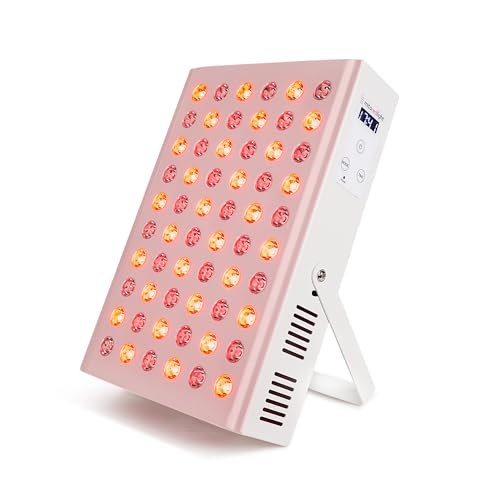
Mito Red Light
MitoMIN 2.0
$249
Pros & Cons
Pros
- Third-party lab tested — 21,720 joules delivered in 10 minutes
- Digital control panel with precise timer (1–20 min)
- Three modes: red only, NIR only, or combined
- FSA/HSA eligible
- Whisper-quiet fans compared to budget competitors
Cons
- Only 2 wavelengths vs. 4–6 on premium Mito models
- Small 12"×9" panel limits coverage to face and neck
- Irradiance spec not prominently listed — less transparent than GembaRed
- Pricier than comparable Hooga tabletop options
At a Glance
Overview
The Mito Red Light MitoMIN 2.0 is a 60-LED desktop panel positioned as an entry point into the Mito Red ecosystem. At $299, it occupies an awkward price position — more expensive than budget competitors with similar specs but less capable than Mito Red's own MitoPRO series, which adds two additional wavelengths and higher irradiance at a $50 premium. What you're largely paying for is the Mito Red brand's track record of independent third-party testing and their accessible three-mode control design.
The MitoMIN 2.0 emits 660nm red and 850nm near-infrared across 60 LEDs in a 12" x 9" panel. One genuine differentiator from budget competitors: the control panel offers three distinct modes — red only, NIR only, or both combined. That mode flexibility matters for users following specific protocols where channel isolation is important, and it sets the MitoMIN apart from the Hooga HG300 and BestQool BQ60 despite comparable LED counts and wavelengths.
The honest assessment is that the MitoMIN 2.0 is a well-built, well-tested panel that serves its niche — but that niche is narrow. Users who want two wavelengths with channel control and trust the Mito Red brand can justify the $299. Users who want the best value per dollar should look at budget panels. Users ready to spend $299+ should seriously consider stepping up to the MitoPRO 300+ at $349 for the four-wavelength advantage.
Mito Red Light MitoMIN 2.0 Red Light Therapy Panel
Prices may change · Free shipping with Prime
Build Quality and Design
The MitoMIN 2.0 is notably lighter than most 60-LED panels at 3.5 lbs, and the compact 12" x 9" x 3" footprint makes it well-suited for desk or nightstand use. The tabletop stand is included and provides stable positioning at a variety of angles. Build quality feels a tier above entry-level plastic construction — the control panel buttons have a solid tactile response and the housing is well-assembled.
The digital control panel is the visible differentiator from budget competitors. Three distinct mode buttons for red-only, NIR-only, and combined operation are clearly labeled. The timer controls are intuitive. Mito Red has clearly invested in a cleaner interface than what most budget competitors offer, and the execution is good.
Wavelength and Irradiance Performance
Mito Red publishes third-party spectroradiometer test data for their products — a transparency standard that most budget brands do not meet. For the MitoMIN 2.0, testing confirms wavelength accuracy at 660nm and 850nm, and irradiance is reported around 75 mW/cm² at 6 inches. That's slightly above the Hooga HG300's ~70 mW/cm² but below the BestQool BQ60's dual-chip output.
The three-mode operation is the performance differentiator that budget panels lack. Running NIR-only (850nm) at lower visual intensity is a practical option for sleep-focused protocols, wound healing applications, or users who want deep tissue penetration without visible red light exposure. Red-only mode (660nm) is useful for surface skincare work where NIR penetration isn't the goal. The combined mode functions identically to what single-mode budget panels offer.
Ease of Use and Setup
The MitoMIN 2.0 arrives fully assembled with the stand attached. The control interface is straightforward: select your mode, set the timer, position at the appropriate distance. Mito Red recommends 6–12 inches for facial skincare and 12–18 inches for broader area work, with sessions of 10–20 minutes per area.
The product documentation and supporting materials from Mito Red are notably better than budget brand equivalents. Protocol guidance covering skin, sleep, recovery, and pain applications is available through their website, which helps new users build effective routines. This support ecosystem is part of what you're paying for at the $299 price point.
Treatment Coverage and Session Times
Coverage area is limited by the 60-LED form factor — face and neck in a single session, with repositioning required for chest, shoulders, or limbs. The 12" x 9" panel face provides slightly more coverage than the 14" x 8" HG300 when used at close range, though the practical difference is minor.
For targeted facial skincare — the primary use case for this panel size — the MitoMIN 2.0's coverage is appropriate. A 10–15 minute combined-mode session covers the face, forehead, and chin adequately at 6–8 inches. Adding a second session for neck and décolletage extends a complete facial routine to 20–25 minutes, which is a common daily practice for skincare-focused users.
Value for Money
This is where the MitoMIN 2.0's value case gets complicated. At $299, it delivers third-party tested specs, independent wavelength control, and a reputable brand, while historical compact-panel listings undercut it substantially. Those archived prices are not current comparison points: the exact BestQool BQ60 offer, for example, was unavailable when checked July 10, 2026. The premium is primarily attributable to brand trust and the three-mode control system.
The more consequential comparison is internal: for $50 more ($349), the Mito Red MitoPRO 300+ adds two additional wavelengths (630nm and 830nm) to the same 60-LED platform, pushing the spectrum into genuinely multi-wave territory with independent channel controls. For a buyer already committed to the Mito Red brand and the $299 price point, the extra $50 is usually worth it. The MitoMIN makes sense primarily for buyers with a hard $300 cap who specifically want Mito Red's testing credibility.
Who Should Buy the Mito Red MitoMIN 2.0 — and Who Shouldn't
Buy the MitoMIN 2.0 if you want Mito Red's third-party testing verification, need independent red/NIR channel control, and have a firm $300 budget ceiling. It's a well-made panel that does its job reliably.
Price-sensitive buyers should compare the current Hooga HG300 offer; the historical BestQool BQ60 was another compact dual-wavelength reference, but its exact Amazon offer was unavailable when checked July 10, 2026, so its old catalog price is not a live comparison point. Also consider the MitoPRO 300+ if its four-wavelength design is worth the step up.
My Verdict
The MitoMIN 2.0 steps up from bare-bones budget panels with a proper digital controller, three operating modes, and verified joule output. It's a solid choice for dedicated face and neck skincare sessions. If you want multi-wavelength or larger coverage, step up to the MitoMEGA line instead.
Mito Red Light MitoMIN 2.0 Red Light Therapy Panel
$249
Prices may change · Free shipping with Prime
| Full Specifications | |
|---|---|
| Wavelengths | 660nm + 850nm |
| Irradiance | 75mW/cm² |
| LED Count | 60 |
| Coverage Area | face / targeted |
| Power Draw | 60W |
| Dimensions | 12" x 9" x 3" |
| Weight | 3.5lbs |
| Wavelength Count | 2 |
| Built-in Timer | Yes |
| Pulsed Mode | No |
| Stand Included | Yes |
| EMF Level | low |
| Warranty | 2years |
| FDA Cleared | No |
Frequently Asked Questions
Is the Mito Red MitoMIN 2.0 worth $299?
How long should I use the MitoMIN 2.0 per session?
What's the difference between the MitoMIN 2.0 and the MitoPRO 300+?
Does the MitoMIN 2.0 have a NIR-only mode?
Mito Red MitoMIN vs Hooga HG300 — which is better?
Related Buying Guides
Compare With Similar Red Light Therapy Devices
BONTANNY
BO-300
630nm + 660nm + 810nm + 830nm + 850nm · 131 mW/cm² · 60
$249
Head-to-Head Comparisons
Mito Red Light MitoMIN 2.0 Red Light Therapy Panel
$249
Prices may change · Free shipping with Prime