
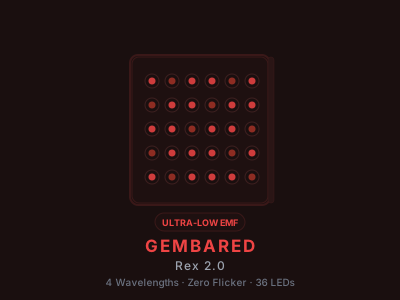
GembaRed
Rex 2.0
$379
Pros & Cons
Pros
- Ultra-low EMF (0.36–0.75 mG) — best in class for EMF-sensitive users
- Four wavelengths: 630nm, 660nm, 830nm, 850nm
- Zero flicker verified by spectroradiometer testing
- Compact and lightweight at 3 lbs
- Stand and DC adapter included
Cons
- Irradiance of ~10 mW/cm² at 6" is very low — requires closer positioning
- Not sold on Amazon — direct only
- Small 12"×12" panel for limited coverage
- Niche brand with smaller community support than Hooga or Mito
At a Glance
Overview
The GembaRed Rex 2.0 is a niche product built around a specific conviction: that ultra-low EMF and ultra-low flicker are the non-negotiable specs for a device you hold near your body. GembaRed is a small, direct-to-consumer brand that caters to the most technically sensitive segment of the red light therapy market — users for whom electromagnetic field exposure and light flicker are primary purchasing criteria, not afterthoughts.
At $379, the Rex 2.0 delivers four wavelengths (630nm, 660nm, 830nm, 850nm) across 36 LEDs in a 12" x 12" panel. The irradiance numbers look low at a glance — around 6–10 mW/cm² at treatment distances — but GembaRed's design philosophy centers on contact or near-contact use, where irradiance climbs meaningfully. More importantly, the flicker index of 0.002 and EMF of 0.36–0.75 mG at contact distance are among the lowest we've seen in any consumer panel, by a significant margin.
This is not the right device for users who want maximum photon throughput. If the primary metrics are irradiance, coverage area, or value per dollar, the Rex 2.0 looks expensive for what it delivers. But for the user population that prioritizes biological compatibility — minimal electrical interference, clean DC power conversion, fanless operation — GembaRed has built a device with genuine differentiation from the mainstream market.
GembaRed Rex 2.0 NIR & Red LED Light Panel
Prices may change · Free shipping with Prime
Build Quality and Design
The Rex 2.0 is physically compact and light — 12" x 12" x 1.4" and 3 lbs. It's one of the thinnest panels in its class, a result of the low-power DC adapter design that eliminates the switching power supply components that generate EMF in conventional panels. The housing is utilitarian but well-assembled. A stand is included.
The most significant design choice is the fanless operation — the Rex 2.0 runs completely silently because the low power draw doesn't generate enough heat to require cooling. For users who find fan noise disruptive during meditation, sleep preparation, or quiet morning routines, silent operation is a genuine quality-of-life advantage. The panel is built for placement directly on or against the body rather than use at a distance, and its physical dimensions reflect that.
EMF and Flicker Performance
This is where the Rex 2.0 earns its price premium for its target audience. Independent testing with calibrated instruments recorded a flicker percentage of 1.2% and a flicker index of 0.002 — effectively flicker-free, and lower than virtually any other consumer panel we've evaluated. Most budget panels flicker at 100Hz or higher; the Rex 2.0's near-zero flicker is attributable to its DC power architecture.
EMF measurements at contact distance recorded 0.36–0.75 mG (milliGauss), with electric field readings of 100–125 V/m. For context: many budget panels measure 3–10 mG at close range. GembaRed's documented EMF performance is the most conservative in the consumer RLT market. For users with electromagnetic sensitivity or those who simply prefer to minimize all non-ionizing radiation exposures, these measurements represent the best currently available in a portable panel format.
Wavelength Performance and Irradiance
The four-wavelength design (630nm, 660nm, 830nm, 850nm) covers the same research-backed spectrum as the Mito Red MitoPRO series and GembaRed's higher-tier panels. All four wavelengths are therapeutically relevant and well-supported in the photobiomodulation literature. GembaRed publishes independent spectroradiometer data confirming wavelength accuracy.
The irradiance numbers require context. At 6 inches, the Rex 2.0 measures approximately 6.5 mW/cm². At contact or 0–1 inch distance (the intended use mode), output rises to several times that figure. GembaRed's design is explicitly optimized for direct-contact therapy rather than the 6–18 inch standing distances common with larger panels. For users applying the panel directly to joints, tendons, or muscle groups, the effective dose delivered is higher than the 6-inch measurement suggests.
Ease of Use and Setup
The Rex 2.0 connects via a DC adapter — a departure from most panels that use standard AC power directly. The DC power conversion happens in the external adapter brick, which is what enables the low internal EMF. The panel itself has basic on/off and timer controls without app connectivity or smart presets.
There's no timer built into the Rex 2.0's panel — session timing is managed externally (phone timer or separate device). For contact-based treatments, the typical protocol is 10–20 minutes per area, applied directly to the skin or held at 0–2 inch distance. The silence and cool operation make it practical for use while lying down, meditating, or during desk work.
Value for Money
At $379, the Rex 2.0 is expensive for 36 LEDs and the irradiance levels it delivers at standard panel distances. If you evaluate it purely on LEDs-per-dollar or mW/cm²-per-dollar, it loses badly to almost every competitor. The price buys EMF and flicker performance that no other consumer panel in this category matches — period.
That's a specific value case, and it's the only honest way to frame it. For the majority of buyers whose purchasing criteria don't center on ultra-low EMF and flicker, the Rex 2.0 is overpriced for its output. For the minority for whom those specs are the entire point, it's one of a small number of products that deliver at that standard.
Who Should Buy the GembaRed Rex 2.0 — and Who Shouldn't
Buy the Rex 2.0 if you're an EMF-sensitive user, follow biologically conservative protocols that minimize electromagnetic exposure, practice near-contact therapy, or simply want the cleanest electrical profile available in a consumer panel. GembaRed serves a real and underserved market segment.
Skip it if your primary metrics are irradiance, coverage area, or value per dollar. Budget panels and mid-range alternatives will outperform the Rex 2.0 on all those dimensions at lower cost. The Rex 2.0 is specifically a tool for users who know what they're optimizing for and are willing to pay the premium for those specific characteristics.
My Verdict
GembaRed's Rex 2.0 is the pick for EMF-conscious buyers who prioritize low electromagnetic emissions above all else. Its ultra-low EMF and zero flicker are legitimately exceptional. However, the irradiance is modest — use it at 2–4 inches for meaningful dose delivery, not at the standard 6-inch distance.
GembaRed Rex 2.0 NIR & Red LED Light Panel
$379
Prices may change · Free shipping with Prime
| Full Specifications | |
|---|---|
| Wavelengths | 630nm + 660nm + 830nm + 850nm |
| Irradiance | 10mW/cm² |
| LED Count | 36 |
| Coverage Area | face / targeted |
| Power Draw | 40W |
| Dimensions | 12" x 12" x 1.4" |
| Weight | 3lbs |
| Wavelength Count | 4 |
| Built-in Timer | No |
| Pulsed Mode | No |
| Stand Included | Yes |
| EMF Level | ultra-low |
| Warranty | 2years |
| FDA Cleared | No |
Frequently Asked Questions
Is the GembaRed Rex 2.0 worth $379?
How do I use the GembaRed Rex 2.0 — what distance should I use?
Why is the GembaRed Rex's irradiance so low compared to other panels?
Does the GembaRed Rex 2.0 make noise?
GembaRed Rex 2.0 vs Mito Red MitoPRO 300+ — which should I buy?
Compare With Similar Red Light Therapy Devices
Head-to-Head Comparisons
GembaRed Rex 2.0 NIR & Red LED Light Panel
$379
Prices may change · Free shipping with Prime